

“Aeroplanes”
At the outbreak of World War I in July of 1914, airplanes (or known then as “aeroplanes”) were still in their infancy. Invented barely 10 years previously, they were made by hand from cloth, wire, and wood. The engines fitted to them were less powerful and less reliable than those in modern automobiles. They were painfully slow and all too prone to accidents. Yet it didn’t take long for military commanders to find potential applications and discover the effectiveness of these radical new machines.
World War I witnessed unprecedented growth and innovation in aircraft design, construction, and as the war progressed – mass production. Each country generated its own innovations sometimes in surprising ways – Albatros, Fokker, Pfalz, and Junkers in Germany and Nieuport, Spad, Sopwith and Bristol in France and Britain.
Each manufacturer and design team vied for the upper hand and deftly and quickly appropriated good ideas from other companies – be they friend or foe. Developments in tactics and deployment also influenced design – from the early reconnaissance planes, to turn fighters, finally planes that relied upon formation tactics, speed, and firepower. Advances were so great that the postwar industry seemed bland by comparison.
WWI biplane Vs A-4
Could a WWI fighter plane shoot down a modern aircraft?
John Chesire, former Naval Aviator, recalls on Quora;
‘Yes, it is possible, but only under very certain conditions, and perhaps with a lot of luck.
‘I once was flying an A-4 Skyhawk low and slow over the Delaware River in the fall [I was flying out of the old Naval Air Development Center (NADC) in Warminster. I lived just over the fence from Willow Grove. This was in the mid-70s. I was flying the A-4 down the Delaware some miles upstream from New Hope], enjoying the colorful display of red and orange tree leaves along its banks.
‘Up ahead I spotted two old WWI biplanes doing a little “tail-chase” maneuvering. I was not aware of any event in the area. They were obviously flying together. Probably just two friends with their vintage planes, out having fun and flying on a beautiful fall day.
‘Fascinated by this I slowed even more and dropped my flaps. As I crossed their flight path, perpendicular and slightly above them, the trailing biplane turned on me, making a simulated attack from my right, forward quarter. I turned to counter, but by then he was in a guns-tracking position only a few hundred feet away. If he had a machine gun, and if his aim were good, he could have shot me down, or have killed me. Even though my A-4 was far more capable than WWI fighters, in this instance I would have lost to an old biplane.’
A good lesson learned
Chesire concludes;
‘Embarrassing! But a good lesson for me. I always wished I had met that pilot to exchange thoughts. I am sure he has told that story, over and over again… and that nobody ever believes him. Had I not witnessed it, I would not have believed it either.’
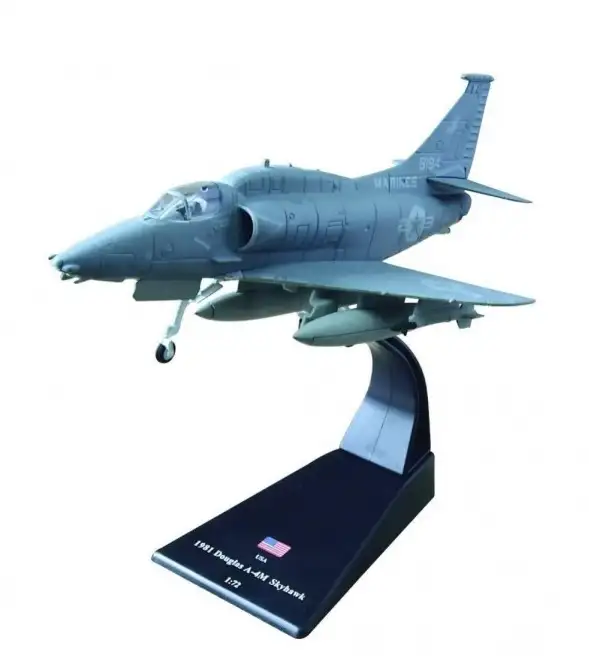
Photo credit: PH2 Lawrence Foster, USN and Alan Lebeda via Wikipedia
Leave a Reply